The paper “BotDigger: Detecting DGA Bots in a Single Network” has appeared at the TMA Workshop on April 8, 2016 in Louvain La Neuve, Belgium (available at http://www.cs.colostate.edu/~hanzhang/papers/BotDigger-TMA16.pdf).
The code of BotDigger is available on GitHub at: https://github.com/hanzhang0116/BotDigger
From the abstract:
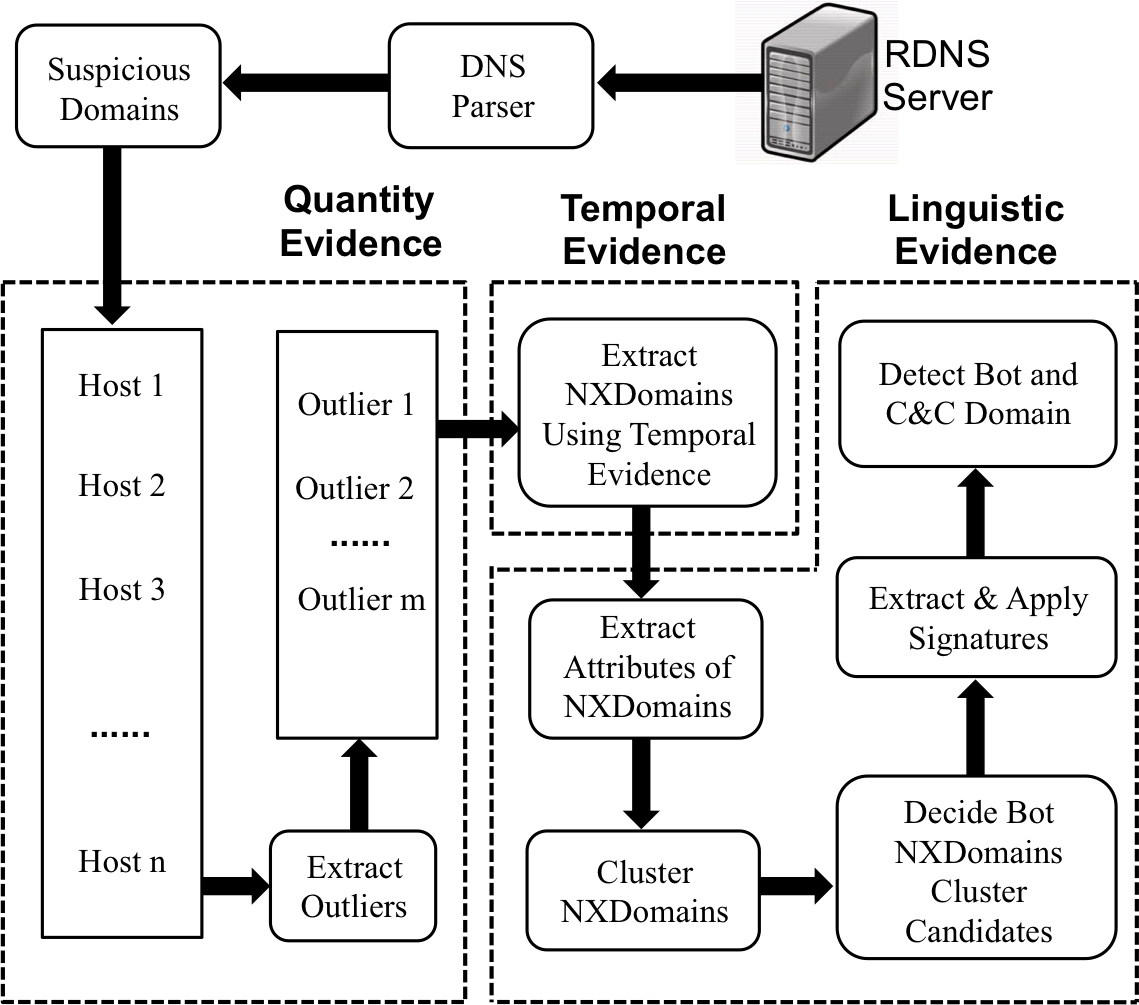
To improve the resiliency of communication between bots and C&C servers, bot masters began utilizing Domain Generation Algorithms (DGA) in recent years. Many systems have been introduced to detect DGA-based botnets. However, they suffer from several limitations, such as requiring DNS traffic collected across many networks, the presence of multiple bots from the same botnet, and so forth. These limitations m
ake it very hard to detect individual bots when using traffic collected from a single network. In this paper, we introduce BotDigger, a system that detects DGA-based bots using DNS traffic without a priori knowledge of the domain generation algorithm. BotDigger utilizes a chain of evidence, including quantity, temporal and linguistic evidence to detect an individual bot by only monitoring traffic at the DNS servers of a single network. We evaluate BotDigger’s performance using traces from two DGA-based botnets: Kraken and Conflicker. Our results show that BotDigger detects all the Kraken bots and 99.8% of Conficker bots. A one-week DNS trace captured from our university and three traces collected from our research lab are used to evaluate false positives. The results show that the false positive rates are 0.05% and 0.39% for these two groups of background traces, respectively.
The work in this paper is by Han Zhang, Manaf Gharaibeh, Spiros Thanasoulas, and Christos Papadopoulos (Colorado State University).

 These limitations make it very hard to detect individual bots when using traffic collected from a single network. In this paper, we introduce BotDigger, a system that detects DGA-based bots using DNS traffic without a priori knowledge of the domain generation algorithm. BotDigger utilizes a chain of evidence, including quantity, temporal and linguistic evidence
![How newtork activity generates DNS backscatter that is visible at authority servers. (Figure 1 from [Fukuda15a]).](http://ant.isi.edu/blog/wp-content/uploads/2015/09/Fukuda15a_icon.png)
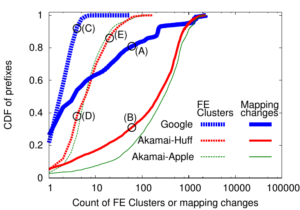 Large web services employ CDNs to improve user performance. CDNs improve performance by serving users from nearby FrontEnd (FE) Clusters. They also spread users across FE Clusters when one is overloaded or unavailable and others have unused capacity. Our paper is the first to study the dynamics of the user-to-FE Cluster mapping for Google and Akamai from a large range of client prefixes. We measure how 32,000 prefixes associate with FE Clusters in their CDNs every 15 minutes for more than a month. We study geographic and latency effects of mapping changes, showing that 50–70% of prefixes switch between FE Clusters that are very distant from each other (more than 1,000 km), and that these shifts sometimes (28–40% of the time) result in large latency shifts (100 ms or more). Most prefixes see large latencies only briefly, but a few (2–5%) see high latency much of the time. We also find that many prefixes are directed to several countries over the course of a month, complicating questions of jurisdiction.