Categories
Uncategorized

New conference paper: “Bounding Mobile Latency from Network Interconnections” at AINTEC 2026

Our new paper “Bounding Mobile Latency from Network Interconnections” will appear at the 2026 Asian Internet Engineering Conference (AINTEC ’26), being held from December 1–3, 2026 in Taipei, Taiwan.
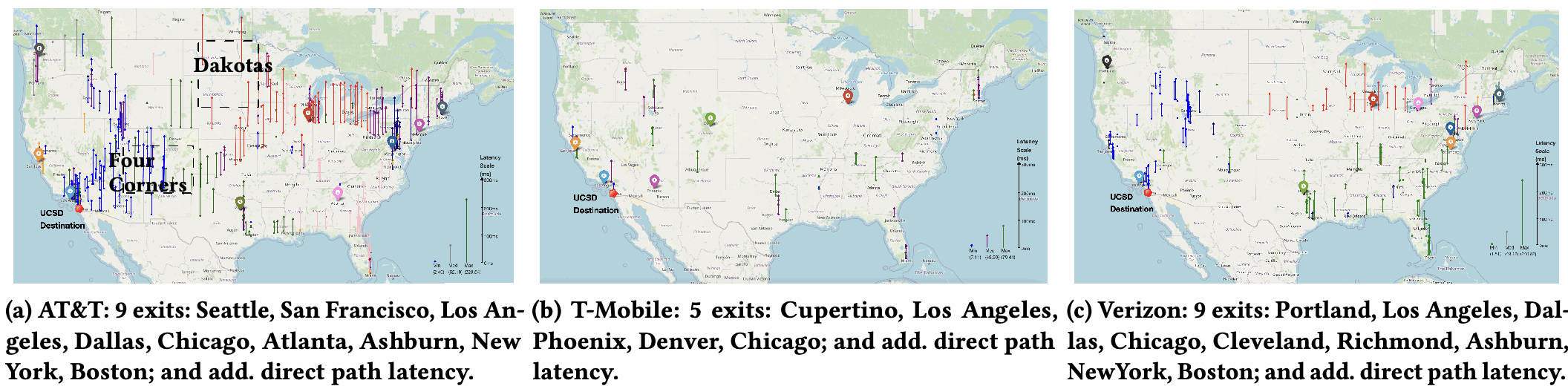
Observed exit points and additional latency relative to an ideal direct path for AT&T (left), T-Mobile (center), and Verizon (right), based on measurements from 2021. Marker locations identify exit points, while line heights show additional latency to a destination in San Diego and line colors identify the exit used. See Sections 4.1 and 4.2 of the paper for details. (Figure 3 from the paper.)
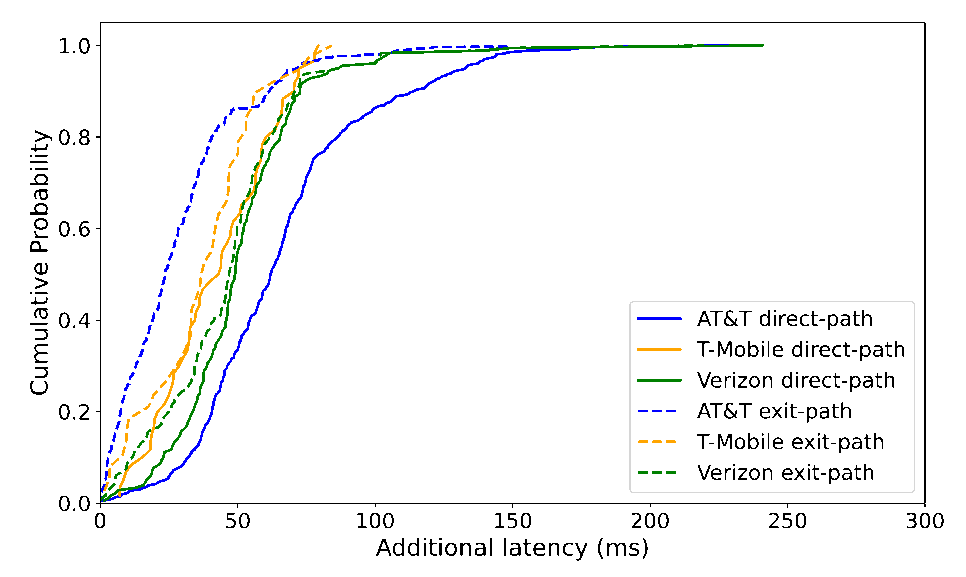
Cumulative distributions of additional latency for AT&T, T-Mobile, and Verizon. Solid lines show latency above an ideal direct path; dashed lines show latency above an ideal path through an operator’s exit point. Substantial additional latency remains even after accounting for the geographic detour through exit points. See Sections 4.2 and 4.3 for details. (Figure 4 from the paper.)

From the abstract:

Mobile latency is determined by how Mobile Network Operators (MNOs) route traffic: from phones, across the MNO’s network to exit points where it enters the public Internet. Exit points are few, and MNOs are quiet about details, but their role prompts us to ask: What is the latency cost to send traffic through an exit point? We develop a new method to evaluate this question, and demonstrate it on the three largest U.S. MNOs, although in principle it can apply globally. Our new analysis of existing traceroutes shows that AT&T, T-Mobile, and Verizon funnel nationwide traffic through only 9, 5, and 9 exits, and the geographic detour they incur adds up to 62.1 ms compared to an ideal, direct-path. We show that even assuming speed-of-light paths through the exit points, up to 46.9 ms of additional latency remains. To understand if these costs can be overcome we compare actual to theoretically optimal placements, finding that latency of current placements is 18–66% above the population and 32–72% above the market-share weighted optimum with the same number of exits. However, we show this gap is small in absolute terms: perfect placement would recover only a few milliseconds of the tens remaining. Geographic optimization offers little: the inflation users experience comes from routing and other overhead.

This paper is joint work of Shefali Tushar Kulkarni and John Heidemann from USC/ISI. This work was supported by DARPA through the SABRES project and by the NSF through the BRIPOD and TEPPIT projects.
Categories
Uncategorized

congratulations to ASM Rizvi for his PhD

I would like to congratulate Dr. ASM Rizvi for defending his PhD at the University of Southern California in June 2024 and completing his doctoral dissertation “Mitigating Attacks that Disrupt Online Services Without Changing Existing Protocols”.

From the dissertation abstract:

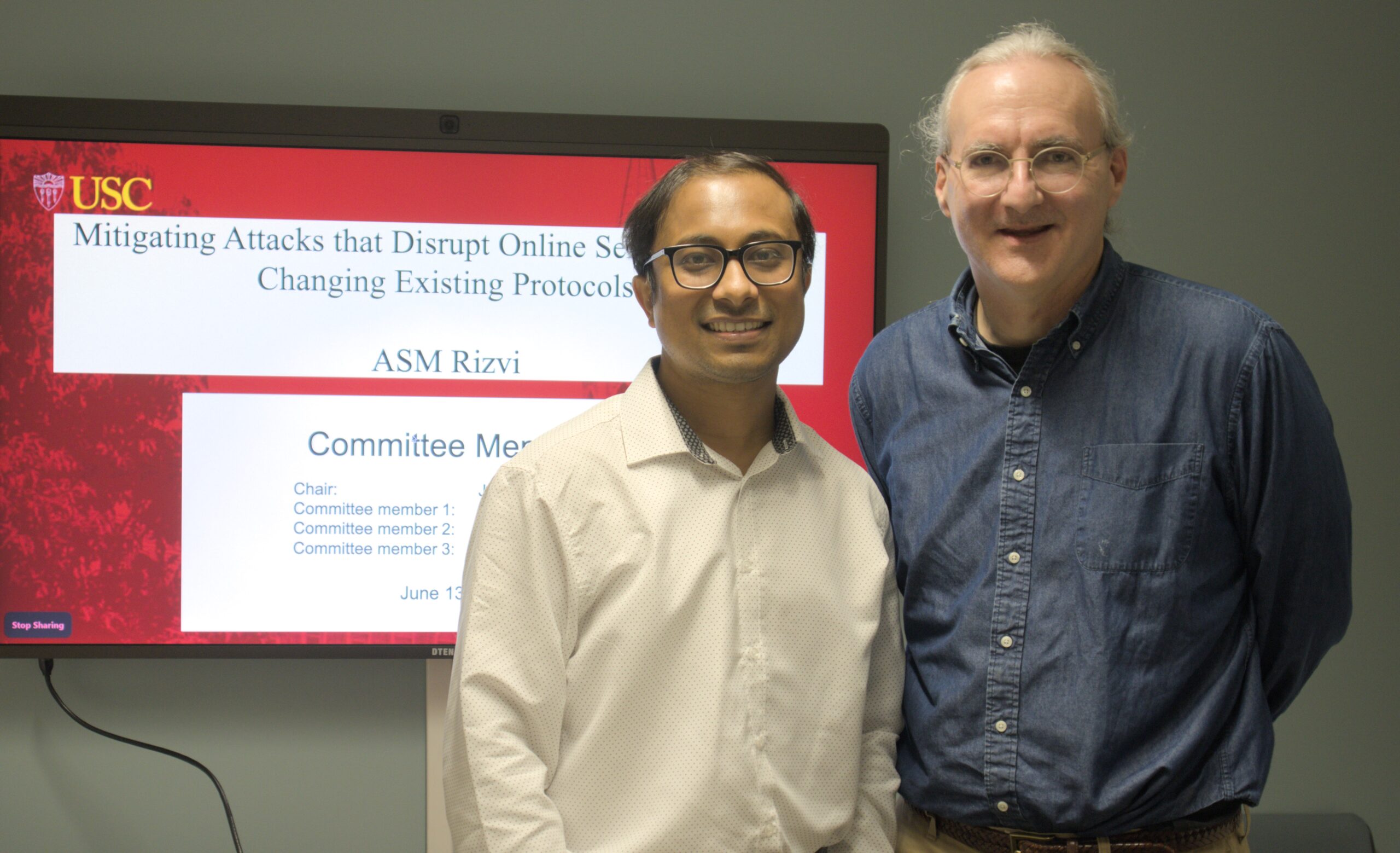
ASM Rizvi and John Heidemann, after Rizvi's PhD defense.

Service disruption is undesirable in today’s Internet connectivity due to its impacts on enterprise profits, reputation, and user satisfaction. We describe service disruption as any targeted interruptions caused by malicious parties in the regular user-to-service interactions and functionalities that affect service performance and user experience. In this thesis, we propose new methods that tackle service disruptive attacks using measurement without changing existing Internet protocols. Although our methods do not guarantee defense against all the attack types, our example defense systems prove that our methods generally work to handle diverse attacks. To validate our thesis, we demonstrate defense systems against three disruptive attack types. First, we mitigate Distributed Denial-of-Service (DDoS) attacks that target an online service. Second, we handle brute-force password attacks that target the users of a service. Third, we detect malicious routing detours to secure the path from the users to the server. We provide the first public description of DDoS defenses based on anycast and filtering for the network operators. Then, we show the first moving target defense utilizing IPv6 to defeat password attacks. We also demonstrate how regular observation of latency helps cellular users, carriers, and national agencies to find malicious routing detours. As a supplemental outcome, we show the effectiveness of measurements in finding performance issues and ways to improve using existing protocols. These examples show that our idea applies to different network parts, even if we may not mitigate all the attack types.

Rizvi’s PhD work was supported by the U.S. Department of Homeland Security’s HSARPA Cyber Security Division (HSHQDC-17-R-B0004-TTA.02-0006-I, PAADDOS) in a joint project with the Netherlands Organisation for scientific research (4019020199), the U.S. National Science Foundation (grant NSF OAC-1739034, DDIDD; CNS-2319409, PIMAWAT; CRI-8115780, CLASSNET; CNS-1925737, DIINER ) and U.S. DARPA (HR001120C0157, SABRES), and Akamai.

Most data from his papers is available at no cost from ANT; please see specific publications for details.