Our new paper “Bounding Mobile Latency from Network Interconnections” will appear at the 2026 Asian Internet Engineering Conference (AINTEC ’26), being held from December 1–3, 2026 in Taipei, Taiwan.
From the abstract:
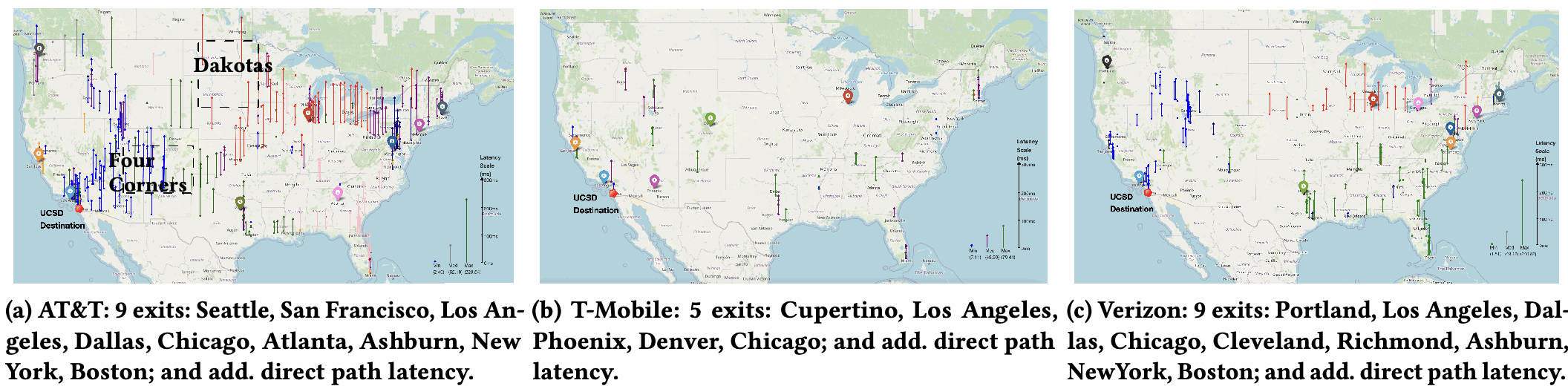
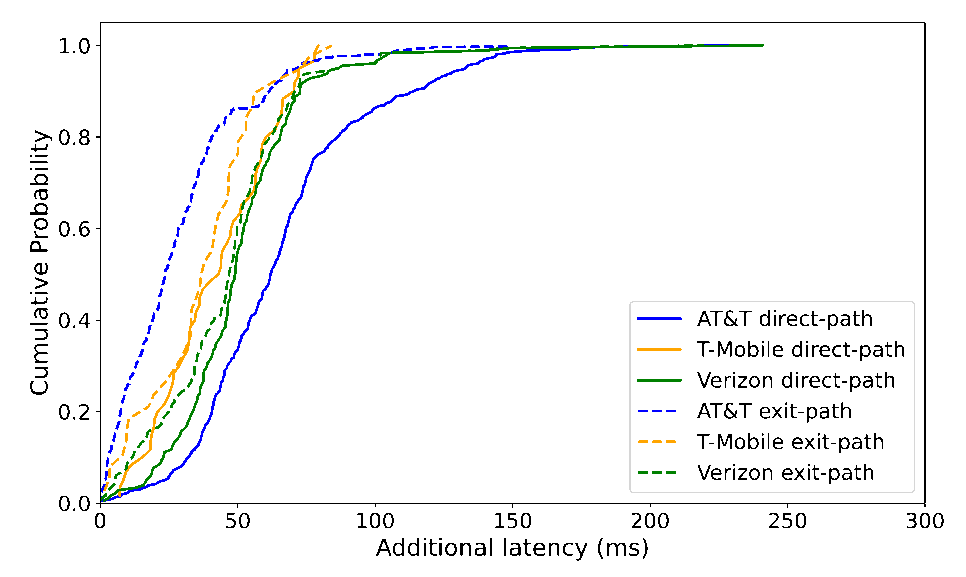
Mobile latency is determined by how Mobile Network Operators (MNOs) route traffic: from phones, across the MNO’s network to exit points where it enters the public Internet. Exit points are few, and MNOs are quiet about details, but their role prompts us to ask: What is the latency cost to send traffic through an exit point? We develop a new method to evaluate this question, and demonstrate it on the three largest U.S. MNOs, although in principle it can apply globally. Our new analysis of existing traceroutes shows that AT&T, T-Mobile, and Verizon funnel nationwide traffic through only 9, 5, and 9 exits, and the geographic detour they incur adds up to 62.1 ms compared to an ideal, direct-path. We show that even assuming speed-of-light paths through the exit points, up to 46.9 ms of additional latency remains. To understand if these costs can be overcome we compare actual to theoretically optimal placements, finding that latency of current placements is 18–66% above the population and 32–72% above the market-share weighted optimum with the same number of exits. However, we show this gap is small in absolute terms: perfect placement would recover only a few milliseconds of the tens remaining. Geographic optimization offers little: the inflation users experience comes from routing and other overhead.
This paper is joint work of Shefali Tushar Kulkarni and John Heidemann from USC/ISI. This work was supported by DARPA through the SABRES project and by the NSF through the BRIPOD and TEPPIT projects.