Categories
Uncategorized

New conference paper: “Understanding Partial Reachability in the Internet Core” at NINeS 2026

Our new paper “Understanding Partial Reachability in the Internet Core” will appear at the 2026 New Ideas in Networked Systems (NINeS), a virtual meeting on February 10, 2026.
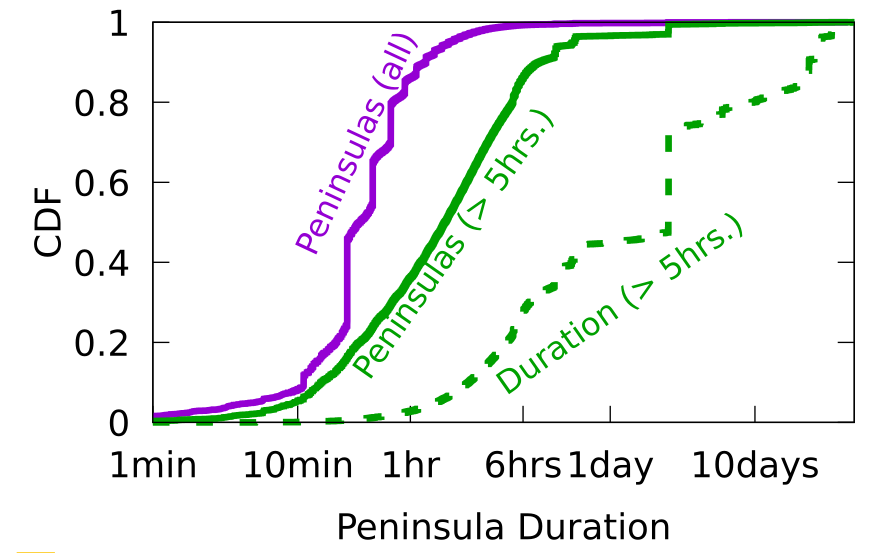
Durations of peninsulas (regions with partial Internet reachability) as seen in 2017q4, showing that most peninsulas are brief, but some persist for days or months (Figure 4 from [Baltra26a]). We see similar results in 2020.

From the abstract:

Routing strives to connect all the Internet, but compete: political pressure threatens routing fragmentation; architectural changes such as private clouds, carrier-grade NAT, and firewalls make connectivity conditional; and commercial disputes create partial reachability for days or years. This paper suggests persistent, partial reachability is fundamental to the Internet and an underexplored problem. We first derive a conceptual definition of the Internet core based on connectivity, not authority. We identify peninsulas: persistent, partial connectivity; and islands: when computers are partitioned from the Internet core. Second, we develop algorithms to observe each across the Internet, and apply them to two existing measurement systems: Trinocular, where 6 locations observe 5M networks frequently, and RIPE Atlas, where 13k locations scan the DNS roots frequently. Cross-validation shows our findings are stable over three years of data, and consistent with as few as 3 geographically-distributed observers. We validate peninsulas and islands against CAIDA Ark, showing good recall (0.94) and bounding precision between 0.42 and 0.82. Finally, our work has broad practical impact: we show that peninsulas are more common than Internet outages. Factoring out peninsulas and islands as noise can improve existing measurement systems; their “noise” is 5x to 9.7x larger than the operational events in RIPE’s DNSmon. We show that most peninsula events are routing transients (45%), but most peninsula-time (90%) is due to a few (7%) long-lived events. Our work helps inform Internet policy and governance, with our neutral definition showing no single country or organization can unilaterally control the Internet core.

A technical report with additional appendices is available from our website and arXiv.

This paper is joint work of Guillermo Baltra, Tarak Saluja, Yuri Pradkin, and John Heidemann, building on work begun when Guillermo was a PhD student at USC and Tarak was a summer undergraduate researcher visiting USC from Swarthmore College.

The work is supported by NSF via the EIEIO, MINCEQ, Internet Map, and BRIPOD projects, and by DARPA via AQUARIUS.

Data created from the work is available at ANT, and the input and validation data is available from ANT, RIPE Atlas, and CAIDA.

Categories
Uncategorized

new technical report “Reasoning about Internet Connectivity”

We have released a new technical report: “Reasoning about Internet Connectivity”, available at https://arxiv.org/abs/2407.14427.

From the abstract:

Figure 1 from [Baltra24b], showing the connected core (A, B and C) with B and C peninsulas, D and E islands, and X an outage.

Innovation in the Internet requires a global Internet core to enable
communication between users in ISPs and services in the cloud. Today, this Internet core is challenged by partial reachability: political pressure
threatens fragmentation by nationality, architectural changes such as
carrier-grade NAT make connectivity conditional, and operational problems and commercial disputes make reachability incomplete for months. We assert that partial reachability is a fundamental part of the Internet core. While some systems paper over partial reachability, this paper is the first to provide a conceptual definition of the Internet core
so we can reason about reachability from first principles. Following
the Internet design, our definition is guided by reachability, not
authority. Its corollaries are peninsulas: persistent regions of
partial connectivity; and islands: when networks are partitioned
from the Internet core. We show that the concept of peninsulas and islands can improve existing measurement systems. In one example,
they show that RIPE’s DNSmon suffers misconfiguration and persistent
network problems that are important, but risk obscuring operationally
important connectivity changes because they are 5x to 9.7x larger. Our evaluation also informs policy questions, showing no single
country or organization can unilaterally control the Internet core.

This technical report is joint work of Guillermo Baltra, Tarang Saluja, Yuri Pradkin, John Heidemann done at USC/ISI. This work was supported by the NSF via the EIEIO and InternetMap projects.

Categories
Uncategorized

new paper “Differences in Monitoring the DNS Root Over IPv4 and IPv6” to appear at the IEEE National Symposium for NSF REU Research in Data Science, Systems, and Security

On December 15, 2022, Tarang Saluja will present the paper “Differences in Monitoring the DNS Root Over IPv4 and IPv6” (by Tarang Saluja, John Heidemann, and Yuri Pradkin) at the IEEE National Symposium for NSF REU Research in Data Science, Systems, and Security.

From the abstract:

Figure 9 from [Saluja22a], showing fraction of query failures in RIPE Atlas after we remove observers that are islands (unable to reach any of the 13 DNS root identifiers). Blue is IPv4, red is IPv6, with data for each of the 13 DNS root identifiers. We believe this data is a better representation of what people expect to see than Atlas results that include these “broken” observers.

The Domain Name System (DNS) is an essential service for the Internet which maps host names to IP addresses. The DNS Root Sever System operates the top of this namespace. RIPE Atlas observes DNS from more than 11k vantage points (VPs) around the world, reporting the reliability of the DNS Root Server System in DNSmon. DNSmon shows that loss rates for queries to the DNS Root are nearly 10% for IPv6, much higher than the approximately 2% loss seen for IPv4. Although IPv6 is “new,” as an operational protocol available to a third of Internet users, it ought to be just as reliable as IPv4. We examine this difference at a finer granularity by investigating loss at individual VPs. We confirm that specific VPs are the source of this difference and identify two root causes: VP islands with routing problems at the edge which leave them unable to access IPv6 outside their LAN, and VP peninsulas which indicate routing problems in the core of the network. These problems account for most of the loss and nearly all of the difference between IPv4 and IPv6 query loss rates. Islands account for most of the loss (half of IPv4 failures and 5/6ths of IPv6 failures), and we suggest these measurement devices should be filtered out to get a more accurate picture of loss rates. Peninsulas account for the main differences between root identifiers, suggesting routing disagreements root operators need to address. We believe that filtering out both of these known problems provides a better measure of underlying network anomalies and loss and will result in more actionable alerts.

Original data from this paper is available from RIPE Atlas (measurement ids are in the paper). We are publishing new results daily on our website (from the RIPE data).

This work was done while Tarang was on his Summer 2022 undergraduate research internship at USC/ISI, with support from NSF grant 2051101 (PI: Jelena Mirkovich). John Heidemann and Yuri Pradkin’s work is supported by NSF through the EIEIO project (CNS-2007106). We thank Guillermo Baltra for his work on islands and peninsulas, as seen in his arXiv report.